

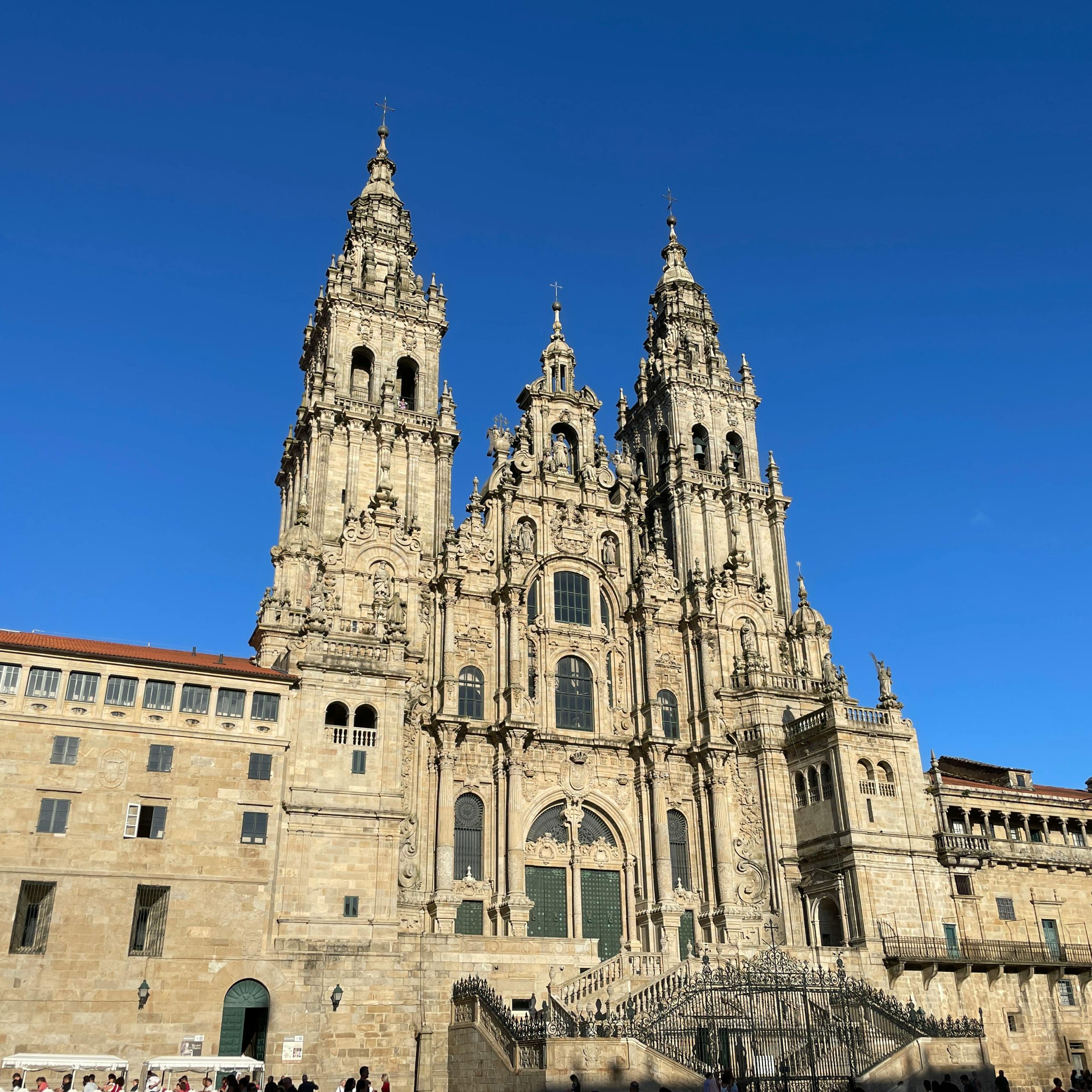
Santiago de Compostela Cathedral, for many pilgrims, is the emotional and symbolic end point of weeks of walking. Every step on the Camino de Santiago builds anticipation for the moment when you finally lay eyes on this remarkable building, often after hundreds of kilometres spent in some well deserved, thoroughly dusty boots!
It is therefore needless to say that arriving at Santiago de Compostela Cathedral is a moment of long awaited celebration.
We have written this guide especially for pilgrims and curious visitors who want to understand its history, artistic layers, and living pilgrim traditions, either before or after their visit. Keep reading!
What is the Santiago de Compostela Cathedral and why is it so important?
Santiago de Compostela Cathedral stands at the heart of the old town of Santiago de Compostela, in the region of Galicia in northwestern Spain. It is most famous for marking the traditional burial place of Saint James the Greater, one of Jesus’ apostles.
For this reason, the Cathedral has been a destination for Christian pilgrimage for more than a thousand years, and this is exactly how the Camino de Santiago originally developed. The Camino is, in fact, one of the oldest walking routes that is still active and widely travelled today.
However, the importance of Santiago de Compostela Cathedral does not lie only in its religious role, but also in what it represents. It is the physical and symbolic destination of all the Camino de Santiago routes, drawing pilgrims from across Europe and far beyond. The most famous Camino routes include the Camino Francés, the Camino Portugués, and the Camino del Norte, but we are also very fond of lesser known yet equally rewarding routes such as the Camino de Invierno, Camino Inglés, Camino Primitivo, and Camino Sanabrés.
It is also worth mentioning that Santiago de Compostela can be not only an ending, but a starting point for a Camino as well. This is the Camino Finisterre, sometimes extended all the way to Muxía, leading to what was once believed to be the edge of the world, at the Atlantic coast of Spain.
A brief history of the Santiago de Compostela Cathedral
The story of Santiago de Compostela Cathedral reaches back to the early Middle Ages, long before the monumental stone structure we see today existed. What began as a modest sacred site gradually evolved into one of the most influential pilgrimage centres in Europe. But the cathedral did not emerge overnight, so let’s see how all that happened!
From the shrine of St. James to a major pilgrimage centre
According to tradition, the tomb of Saint James the Greater was discovered in the early ninth century, after a local hermit reported seeing mysterious lights shining over a forested hill. These lights were interpreted as a divine sign, guiding the way to a long forgotten burial site.
When the remains were identified as those of the apostle, the discovery quickly gained religious significance.
Here is a little history lesson for the context: at the time, Christian kingdoms in the Iberian Peninsula were consolidating power during the Reconquista. During this long period, Christian rulers gradually expanded their territories southward, reshaping the political and religious map of the region. Therefore, the presence of an apostolic tomb in the far west of Europe strengthened both spiritual authority and political legitimacy.
A small church was built to house these relics, and word spread rapidly along monastic networks and trade routes. Pilgrims began arriving from across the continent, first in modest numbers, then in steadily increasing waves.
Over time, roads formed, hostels appeared, and Santiago de Compostela transformed from a remote settlement into a thriving pilgrimage city. By the High Middle Ages, it stood alongside Rome and Jerusalem as one of the three great destinations of Christian pilgrimage.
Construction, styles and transformations over the centuries
As pilgrim numbers grew, the need for a larger and more durable church became unavoidable. Construction of the Romanesque cathedral began in the late eleventh century, designed specifically with pilgrimage in mind. Wide aisles, an ambulatory behind the altar, and multiple chapels allowed pilgrims to circulate without disrupting religious services.
For our artsy readers: this original Romanesque structure still forms the backbone of the cathedral, but it did not remain unchanged. Over the centuries, Gothic elements were introduced, particularly in chapels and structural reinforcements. Later, during the Baroque period, façades and decorative flourishes were added, most famously on the western entrance facing the Obradoiro square.
These additions to Santiago de Compostela Cathedral were not merely aesthetic, but often reflected new liturgical practices and the desire to present the cathedral as a symbol of prestige and continuity. Fires also occurred over the centuries, and restorations and modern conservation efforts further shaped the building, ensuring its survival into the present day. So eather than representing a single moment in history, Santiago de Compostela Cathedral is the result of almost a thousand years of transformation!
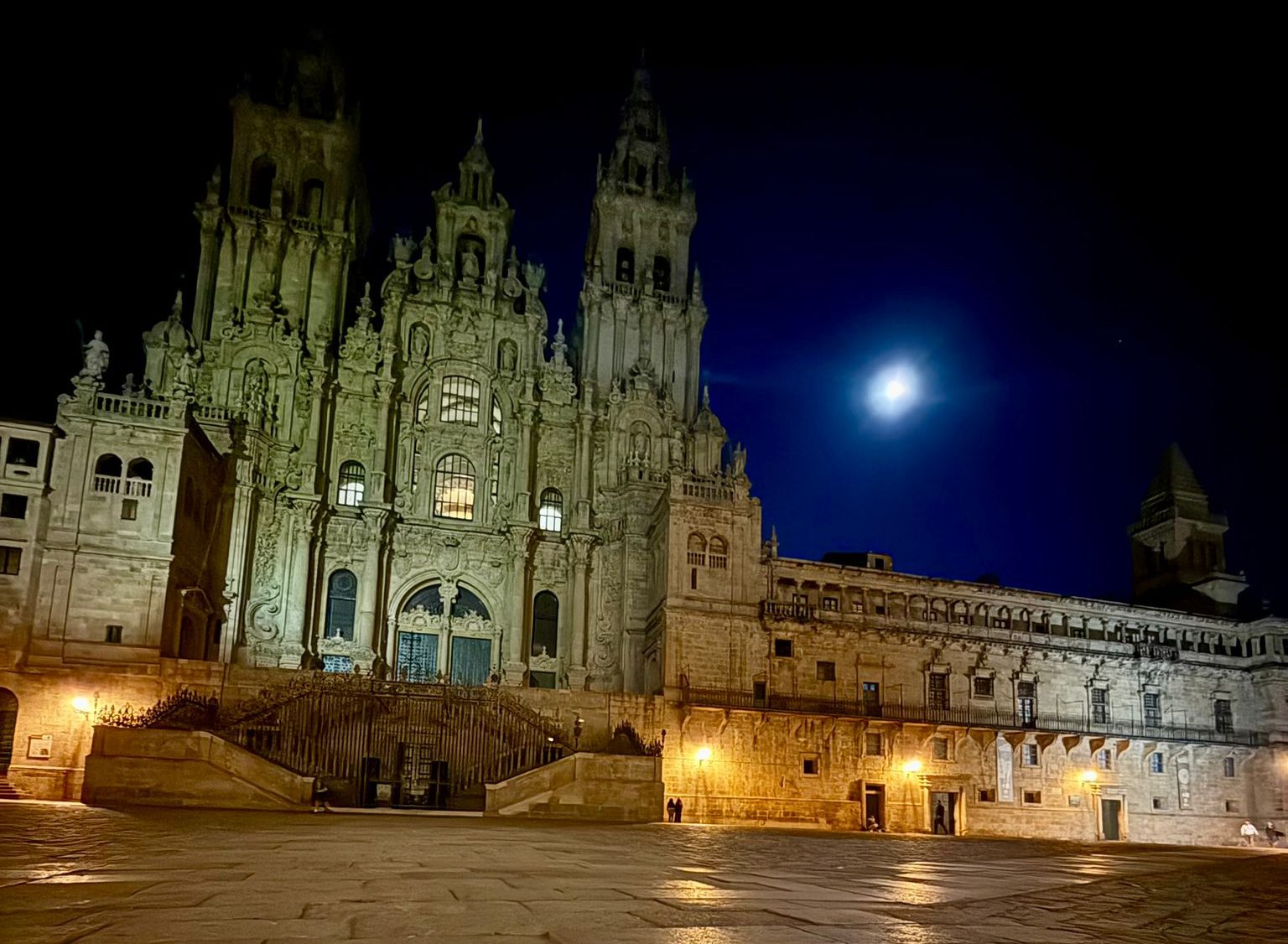
Main highlights inside the Santiago de Compostela Cathedral
Taking time to explore the interior reveals spaces filled with meaning for pilgrims and visitors alike. You might feel overwhelmed by emotions when you arrive in Santiago as a pilgrim, so it is helpful to read a little about Santiago de Compostela Cathedral in advance. We also encourage you to consider paying a second visit to this magnificent building.
Here are the key highlights you should not miss:
The main altar and the statue of St. James
The richly decorated main altar is one of the most recognisable elements of Santiago de Compostela Cathedral. Behind it stands the statue of Saint James, traditionally embraced by pilgrims as a gesture of gratitude and completion, marking the end of the Camino and pausing to acknowledge the journey and everything it carried. This practically means that pilgrims queue to walk up behind the altar and place their arms around the statue and is one of the most meaningful moments on the Camino for many pilgrims.
The crypt and the relics of St. James
In Santiago de Compostela Cathedral, the crypt lies directly below the high altar, placing it at the symbolic and physical centre of the building. Traditionally, a crypt is an underground chamber, usually located beneath the main altar of a church, and used for burials or to house sacred relics.
The relics – the human remains believed to belong to Saint James the Greater – are kept in the crypt of Santiago de Compostela Cathedral because Christian tradition holds that churches built over the burial place of a saint derive their spiritual significance from that exact location.
As mentioned above, the location of the relics was lost for several hundred years and only confirmed again in the late nineteenth century, when archaeological investigations and Vatican recognition reaffirmed their presence in the crypt. It is therefore remarkable that today they can be visited! For pilgrims, this means that the long journey across Europe leads quite literally to the place where the apostle is said to rest.
Other corners worth noticing
Those with more time inside Santiago de Compostela Cathedral may wish to move beyond the central nave and explore some of its quieter spaces. Side chapels, often dedicated to different saints, reflect centuries of devotion and patronage, and are still used today for private prayer and smaller services.
The cathedral’s organs, among the largest in Spain, dominate the interior both visually and acoustically, reminding visitors that music has long played a central role in liturgy and pilgrimage celebrations.
Additionally, the Cathedral Museum provides further context, displaying liturgical objects, manuscripts, and artworks that reveal how Santiago de Compostela Cathedral has evolved over time.
The famous Botafumeiro: what you need to know
The Botafumeiro is the giant incense burner that occasionally swings across the transept of Santiago de Compostela Cathedral during special services. Suspended from the ceiling by a complex system of ropes and pulleys, it is set in motion by a team of cathedral attendants who coordinate its movement with remarkable precision. Once released, the Botafumeiro arcs high above the congregation, filling the space with incense and drawing all eyes upward.
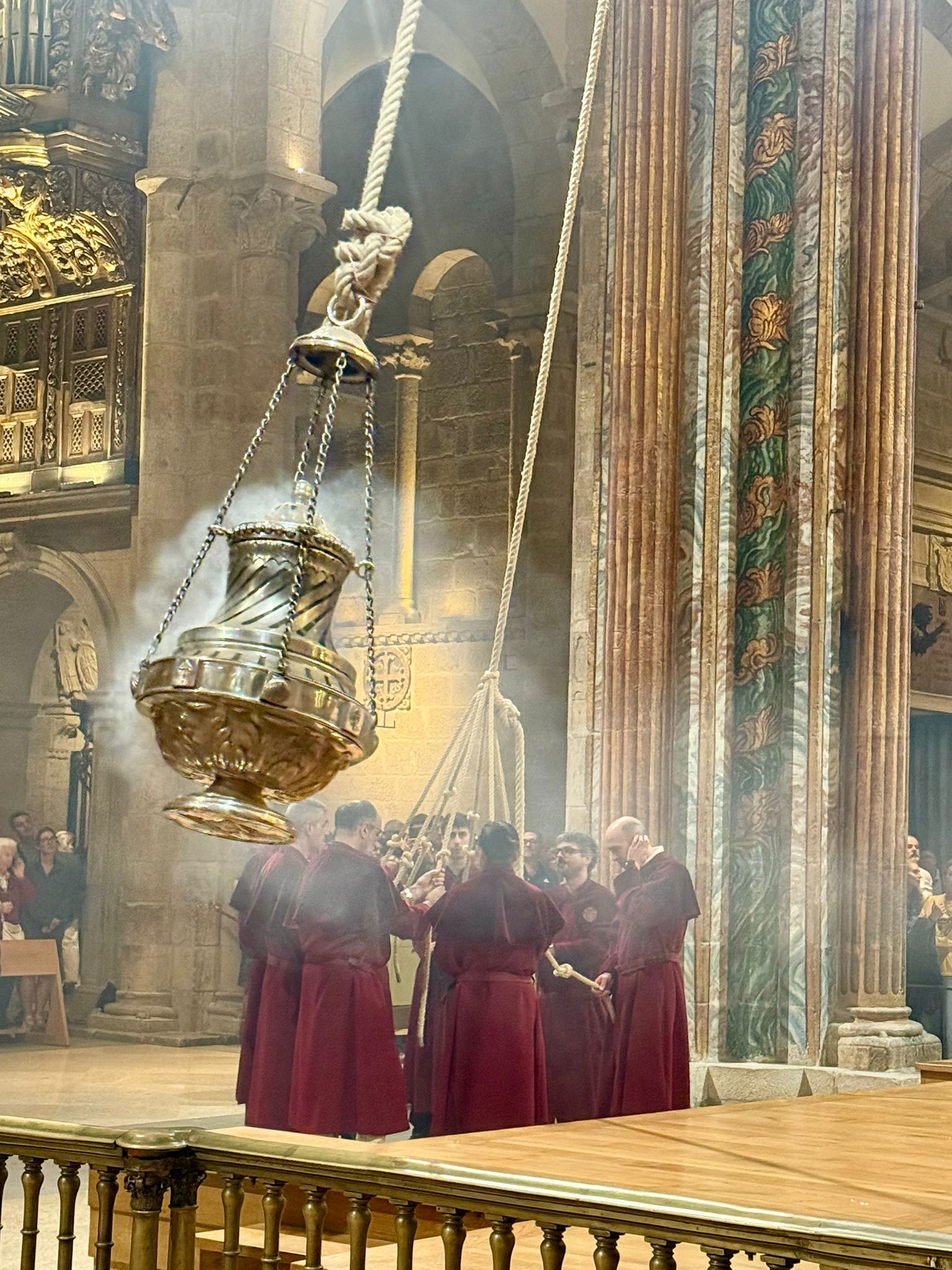
Historically, its function was both practical and symbolic. In the Middle Ages, large numbers of pilgrims arrived after weeks or months of walking, often in crowded conditions. Burning incense helped purify the air, while the dramatic movement reinforced the sacred atmosphere of the cathedral.
Today, the Botafumeiro is one of the most recognisable symbols of Santiago de Compostela Cathedral, but it does not swing during every Mass. Its use is reserved for specific liturgical feast days or when a private donation has been made to fund the operation. Visitors should therefore be aware that its appearance is never guaranteed, and schedules can change without notice.
The Pilgrim’s Mass at Santiago de Compostela Cathedral
The Pilgrims’ Mass is held daily at Santiago de Compostela Cathedral and is open to everyone, regardless of whether you have walked a full Camino route or are visiting as a traveller. The service follows the Catholic liturgy, but it is shaped with pilgrims in mind, often including a welcome spoken in several languages and a mention of the countries from which pilgrims have arrived that day.
Up to date Pilgrims’ Mass schedules are always published on the official website of the Pilgrims’ Office, making it easy to check times before your visit. As a rule of thumb, the Mass usually takes place at a fixed time, although schedules can change depending on the season or special celebrations. Seating is limited and the cathedral can fill quickly, especially in high season, so arriving early is recommended for those who wish to sit.
Planning your Camino and visit to Santiago de Compostela Cathedral
Arriving at Santiago de Compostela Cathedral is part of the mesmerising journey of the Camino, where thoughtful planning can make the experience just as meaningful as the moment you finally step inside. If you would like support in shaping a Camino that reflects your interests, pace, and intentions, feel free to reach out to us at [email protected] for tailor made guidance. We have worked alongside thousands of pilgrims over the years and would love to welcome you into the WAW community!

Comment (0)